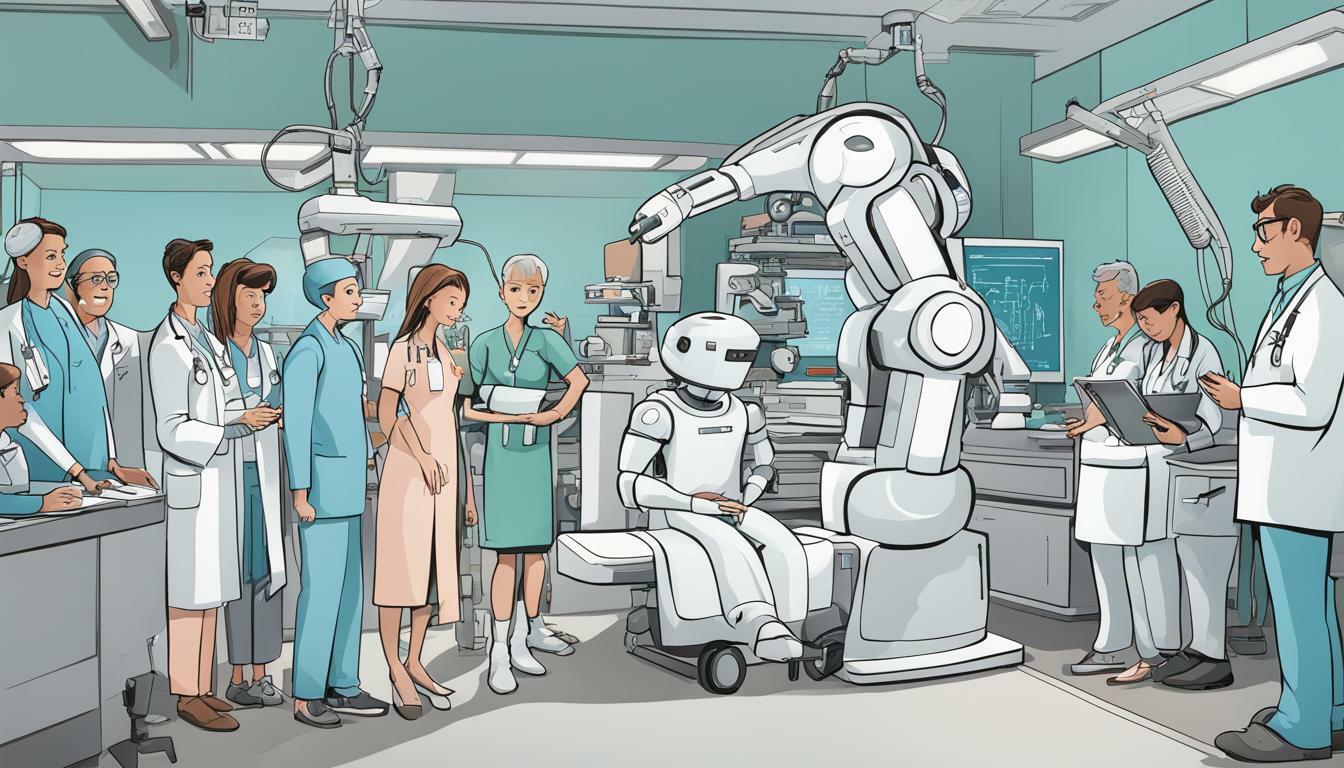
Artificial intelligence is rapidly evolving, and Super AI is at the forefront of this technological revolution. Super AI, or advanced or cutting-edge AI, refers to state-of-the-art AI technologies that exceed human-level intelligence and capability. The potential of Super AI to transform various industries and improve human lives is limitless.
This article will explore several Super AI examples showcasing its innovative applications and groundbreaking implementations across domains. Super AI is revolutionizing how we live, work, and interact, from healthcare to agriculture, education to finance.
Key Takeaways:
- Super AI refers to state-of-the-art AI technologies that exceed human-level intelligence and capability.
- Super AI has the potential to revolutionize various industries and improve human lives.
- This article will explore several Super AI examples across different domains.
Advancing Medicine: Super AI in Healthcare
Super AI is making strides in advancing diagnosis, treatment, and drug discovery in healthcare. Medical professionals are harnessing the power of advanced artificial intelligence examples to revolutionize modern medicine.
One of the cutting-edge AI use cases is AI-powered diagnosis. Medical professionals can use machine learning algorithms to analyze patient data and identify patterns that may go unnoticed. The state-of-the-art AI technology examples allow for earlier and more accurate diagnoses, improving patient outcomes.

Another innovative AI application in healthcare is the use of personalized treatment plans. With AI algorithms, doctors can tailor treatment plans based on patient data, such as genetics and medical history. This individualized approach can potentially improve patient outcomes and reduce healthcare costs.
Super AI is also transforming drug discovery. Drug development is notoriously time-consuming and expensive, but AI-powered systems can analyze vast amounts of data to identify potential drug candidates much faster. Researchers can use these next-generation AI demonstrations to accelerate the discovery of new treatments and bring them to market more quickly.
In conclusion, Super AI is advancing healthcare in countless ways. From AI-powered diagnosis to personalized treatment plans and drug discovery, innovative technology is revolutionizing modern medicine and improving patient outcomes.
Transforming Transportation: Super AI in Autonomous Vehicles
Super AI is at the forefront of transforming the transportation industry through its advances in the development of autonomous vehicles. With cutting-edge AI use cases and innovative AI applications, next-generation AI demonstrations are paving the way toward revolutionizing how we travel.
Self-driving cars are one of the most well-known examples of Super AI in transportation. These cars are equipped with state-of-the-art AI technology, allowing them to analyze and interpret data from sensors, cameras, and other sources to navigate the roads safely. Predictive maintenance is another area where Super AI is transforming transportation. By analyzing data from various sources, AI-powered systems can predict and prevent mechanical failures, ensuring that vehicles are always safe and reliable.

Another example of Super AI in transportation is traffic optimization. AI can help reduce congestion, streamline traffic flow, and increase road safety by analyzing traffic patterns and real-time data. These innovations in next-generation AI demonstrations will not only improve the efficiency of transportation but also the safety of passengers and drivers alike.
Overall, Super AI is transforming the transportation industry, paving the way for a future of more accessible, efficient, and safer travel. Its innovative AI applications and cutting-edge AI use cases will continue to drive the development of autonomous vehicles and other transportation technologies, bringing us closer to a world where human error is eliminated and transportation is optimized.
Enhancing Customer Experience: Super AI in Chatbots
Artificial intelligence has broad applications across various industries and has become a game-changer in providing a more personalized customer experience. One of the most notable examples is the use of Super AI in chatbots, which has revolutionized how companies interact with their customers. Chatbots powered by Super AI technology can provide real-time support, make personalized recommendations, and enhance brand interactions.
Cutting-edge AI use cases in chatbots have been embraced by many businesses, enabling them to improve their customer service offerings and streamline the customer experience. State-of-the-art AI technology examples in chatbots showcase superior intelligence that helps them easily understand customer queries and provide speedy and accurate responses. Revolutionary AI showcases such as chatbots offer 24/7 support and can handle multiple questions simultaneously without compromising the quality of the service.
Top-notch AI illustrations in chatbots showcase how businesses in different industries have adopted AI technology for better customer engagement. One such example is Pizza Hut, which successfully implemented a chatbot on Facebook Messenger to take orders and provide customer support. The chatbot, “Dom,” can answer questions about menu items, track orders, and provide recommendations based on customer preferences. Such examples show how Super AI chatbots can enhance customer experience and enable businesses to deliver personalized services.

Businesses also use Super AI chatbots for predictive personalization. They analyze customer data, such as past purchases and behaviors, to offer highly personalized recommendations that match customer preferences and needs. This enhances customer satisfaction and loyalty and improves the overall customer experience.
Overall, Super AI chatbots transform how companies interact with customers, providing personalized support, recommendations, and interactions. The state-of-the-art AI technology examples in chatbots show that AI technology has become essential for businesses that want to offer a superior customer experience.
Revolutionizing Manufacturing: Super AI in Robotics
The intersection of Super AI and robotics is transforming the manufacturing industry. Advanced artificial intelligence examples and cutting-edge AI use cases have led to innovative AI applications and groundbreaking AI implementations in the form of AI-powered robots. These robots can automate complex tasks, optimize production processes, and ensure quality control.
One of the most significant examples of Super AI in manufacturing is the development of collaborative robots or cobots. These robots work alongside human workers to improve efficiency and productivity in industrial settings. With their advanced sensing and perception capabilities, cobots can perform various tasks, such as material handling, assembly, and welding.

Additionally, Super AI is used in predictive maintenance, where robots analyze data and monitor machinery to predict when maintenance is needed. This level of automation increases efficiency and reduces downtime and maintenance costs. Moreover, Super AI is used to optimize production processes, where manufacturing equipment can adapt in real-time to adjust to changing production demands, thus reducing waste.
Overall, Super AI and robotics combine to revolutionize the manufacturing industry. With advanced AI technology examples and innovative AI applications, manufacturers can improve productivity, reduce errors, and optimize efficiency.
Empowering Financial Services: Super AI in Fraud Detection
One of the most significant ways Super AI transforms the financial services industry is through its advanced fraud detection capabilities. With cutting-edge AI use cases, innovative AI applications, state-of-the-art AI technology examples, and top-notch AI illustrations, fraud detection has become more efficient and reliable.
AI systems analyze vast amounts of data in real-time to identify fraudulent activities, such as transactions that deviate from typical patterns, suspicious user behavior, and fraudulent claims. By detecting fraudulent activities and preventing them from happening in the first place, Super AI is helping financial institutions save millions of dollars and protect their clients’ assets.
One example of Super AI in action is the AI-powered fraud detection system developed by JP Morgan Chase. This system uses machine learning algorithms to examine customer transactions and identify signs of fraud. 2019, this system helped the bank save over $500 million in potential losses.
Benefits of Super AI in Fraud Detection
The benefits of Super AI in fraud detection are numerous and highly valuable to financial institutions and their clients. Some of these benefits include:
- The ability to analyze vast amounts of data in real-time, which enables early identification and prevention of fraudulent activities
- Increased accuracy in detecting fraudulent activities, reducing false positives, and ensuring that legitimate transactions are not mistakenly flagged as fraudulent.
- Reduced costs associated with fraud detection and prevention
- Improved client trust and loyalty by providing a secure and reliable banking experience.
Super AI is transforming the financial services industry and improving financial transactions’ overall security and trustworthiness. Its cutting-edge AI use cases, innovative AI applications, state-of-the-art AI technology examples, and top-notch AI illustrations have enabled fraud detection to become more efficient, reliable, and effective than ever before.

Transforming Education: Super AI in Personalized Learning
Super AI is revolutionizing industries like healthcare and manufacturing and transforming how we approach education. Advanced artificial intelligence examples are already being used to personalize learning experiences for individual students, providing targeted feedback and optimizing curriculum delivery.
Next-generation AI demonstrations in education include AI-powered platforms like Knewton, which adapts to individual student needs and provides real-time feedback on their progress. Another innovative AI application is Carnegie Learning’s Mathia software, which uses AI to create individualized math assignments that challenge and engage students at their skill level.
These cutting-edge AI use cases are not limited to K-12 education. At the university level, AI-powered chatbots are being used to enhance student support services, providing personalized recommendations and real-time support. The University of Georgia’s chatbot, Pounce, has already answered over 200,000 student inquiries, assisting with everything from registration to financial aid.
With the help of Super AI, education is becoming more personalized and accessible to learners of all ages and backgrounds. The potential of innovative AI applications in education is vast, with the capacity to transform how we learn and teach.

Personalized Learning with the Help of Super AI
Personalized learning is the future of education, and Super AI is at the forefront of this transformation. With advanced artificial intelligence examples like Knewton and Mathia, students can learn at their own pace and level, receiving feedback and support tailored to their needs.
One example of the impact of personalized learning with the help of Super AI is the “DreamBox effect.” DreamBox Learning, an AI-powered platform for early math education, has been shown to significantly improve student achievement, with students who used the platform performing 59% better than their peers.
As more innovative AI applications are developed in education, the possibilities of personalized learning with Super AI are limitless. The future of education is bright with the promise of Super AI.
Innovating Agriculture: Super AI in Precision Farming
Super AI is revolutionizing the agricultural industry through precision farming techniques. One example is AI-based irrigation systems that use sensors to optimize water usage based on soil moisture levels, weather patterns, and crop types. By reducing water waste and improving efficiency, these systems have the potential to increase crop yields and reduce operational costs significantly.
Another cutting-edge AI use case in agriculture is crop monitoring and management. AI-powered drones with cameras and sensors can gather data on crop health, soil conditions, and growth patterns. This data can then be analyzed in real-time to optimize planting, fertilization, and harvesting processes. State-of-the-art AI technology examples transform agriculture from a guesswork-based industry to a data- and analysis-driven one.

Revolutionary AI showcases that AI-powered robots are transforming how crops are planted, tended, and harvested. These robots use AI algorithms to navigate fields, plant seeds, apply fertilizers and pesticides, and harvest crops. They can work around the clock and eliminate human labor costs, making farming more efficient and cost-effective. AI-powered robots are also used to perform quality control tasks, such as identifying and removing damaged crops, which is time-consuming and difficult for human workers.
Innovative AI applications have also been developed to analyze and predict weather patterns, helping farmers make informed decisions about planting and harvesting timelines. These state-of-the-art AI technology examples can help farmers avoid yield losses due to sudden weather changes, prevent crop damage from unexpected weather events, and optimize production cycles.
Redefining Creative Industries: Super AI in Art and Music
Super AI is transforming various industries and redefining the creative industries, specifically art and music. Innovative AI applications have enabled machines to create artworks and compose music rivaling human creations.
State-of-the-art AI technology examples in art include generative adversarial networks (GANs), which create images that are hard to distinguish from human-made art. An incredible example of GAN-generated art is “Portrait of Edmond de Belamy,” which sold for $432,500 at a Christie’s auction in 2018. GANs have also been used to create AI-generated music indistinguishable from human-made music. Groundbreaking AI implementations allow machines to learn from a vast database of existing works and then use that knowledge to create new pieces.
Another Revolutionary AI showcase in the creative industries is virtual reality. Super AI has enabled machines to create virtual environments almost identical to the real world. The music industry is using VR to create immersive experiences for fans. For example, a VR headset can transport someone to a live concert, where they can experience the show as if they were in the front row.
The promising potential of Super AI in the creative industries is vast and could change how we experience art and music. However, it also raises ethical considerations about the role of AI in creative control and ownership. The development of responsible AI regulations is necessary to ensure that Super AI benefits rather than harms our society.

Shaping the Future: Ethical Considerations of Super AI
The rise of Super AI brings unprecedented advancements and opportunities across various industries. However, as with any new technology, it also raises ethical concerns and potential risks that must not be ignored.
Advanced artificial intelligence examples, cutting-edge AI use cases, innovative AI applications, state-of-the-art AI technology examples, next-generation AI demonstrations, futuristic artificial intelligence case studies, groundbreaking AI implementations, revolutionary AI showcases, and top-notch AI illustrations- all demonstrate the potential of Super AI. Still, they also create concerns about discrimination, job displacement, and loss of privacy.
One of the significant ethical considerations of Super AI is the possibility of bias. AI systems are only as neutral as the data they are trained on. If the data sets that train a system contain biases, the AI system will inherit and perpetuate them. Algorithms based on biased data could, for instance, lead to hiring decisions that discriminate against certain groups or even perpetuate racial and gender inequalities.
Another concern is the displacement of human labor. As Super AI becomes more advanced, more jobs will become automated. This could lead to significant job losses, particularly in sectors such as manufacturing and transportation. Additionally, Super AI could lead to increased income inequality, with those who can adapt to new job requirements benefiting from the technology. At the same time, those who lack the necessary skills are left behind.
The potential loss of privacy is also a significant concern with Super AI. AI systems can collect, analyze, and process large amounts of data. As such, they could be used to infringe on personal privacy, particularly if government or corporate entities have access to them without proper regulation in place.
The development and implementation of Super AI must be done responsibly and regulated. Governments, industries, and organizations must work together to establish ethical guidelines and ensure that Super AI is used for the betterment of society as a whole.
The Importance of Responsible AI Development
Responsible AI development involves ensuring that AI systems are developed in a way that is transparent, accountable, and unbiased. This means that the development process of Super AI should be monitored and regulated to ensure that it aligns with ethical standards.
Additionally, AI systems should be audited regularly to determine whether they contain biases or errors. If such biases or mistakes are identified, they should be addressed promptly to ensure that the system operates fairly and accurately.
Furthermore, there should be transparency in the use of AI systems. Organizations should be required to disclose the use of AI systems and explain how they are being used to make decisions. This would help to ensure that individuals are not subject to unfair discrimination.
The Importance of AI Regulation
Regulation of Super AI is also crucial to minimizing potential risks and ensuring its responsible use. Governments and regulatory bodies should establish guidelines that govern the development and use of Super AI.
Regulations should be designed to ensure that AI systems are developed transparent, accountable, and unbiasedly. They should also be designed to address concerns such as job displacement and loss of privacy.
Additionally, regulations should ensure transparency in the use of AI systems and that individuals have the right to access and control their data.
As the development of Super AI continues, ethical considerations must be considered. By ensuring that Super AI is developed and used responsibly and regulated, we can take advantage of its enormous potential to transform various industries while minimizing potential risks and ensuring the well-being of society as a whole.

The Promising Potential of Super AI
As evidenced by the examples explored in this article, Super AI has the potential to revolutionize various industries and improve human lives in numerous ways. Whether in healthcare, transportation, customer experience, manufacturing, financial services, education, agriculture, or the creative industries, Super AI is paving the way for cutting-edge and innovative applications that were once thought impossible.
AI-powered diagnosis and personalized treatment plans in healthcare, self-driving cars and predictive maintenance in transportation, and AI-generated artworks and music compositions in the creative industries are just a few examples of the limitless potential of Super AI.
However, it’s essential to consider the ethical implications of rapidly advancing AI technology and its potential impact on society. Responsible AI development and regulation must be a top priority to mitigate potential risks and ensure that Super AI is used to benefit humanity.
Super AI presents exciting opportunities for industry leaders, innovators, and society. By embracing the potential of this revolutionary technology, we can usher in a new era of intelligence and progress.
FAQ
Q: What is Super AI?
A: Super AI refers to advanced artificial intelligence that surpasses human-level intelligence in various domains. It has the potential to revolutionize industries and reshape the future of intelligence.
Q: What are some examples of Super AI applications?
A: Super AI can be found in various fields, including healthcare, transportation, customer experience, manufacturing, financial services, education, agriculture, and the creative industries. It powers AI systems such as autonomous vehicles, chatbots, robotics, fraud detection, personalized learning platforms, precision farming techniques, and AI-generated art and music.
Q: How is Super AI advancing medicine?
A: Super AI revolutionizes healthcare by enabling AI-powered diagnosis, personalized treatment plans, and drug discovery. It has the potential to improve patient outcomes and enhance the efficiency of healthcare delivery.
Q: How is Super AI transforming transportation?
A: Super AI is driving the development of autonomous vehicles, optimizing traffic, and enabling predictive maintenance. It can potentially make transportation safer, more efficient, and environmentally friendly.
Q: How is Super AI enhancing customer experience?
A: Super AI is improving customer experience through AI-powered chatbots. These chatbots provide personalized recommendations, offer real-time support, and enhance brand interactions, improving customer satisfaction.
Q: How is Super AI revolutionizing manufacturing?
A: Super AI is transforming the manufacturing industry through robotics. AI-powered robots automate complex tasks, optimize production processes, and ensure quality control, increasing productivity and efficiency.
Q: How is Super AI empowering financial services?
A: Super AI is empowering financial services by detecting and preventing fraud. AI systems analyze large amounts of data in real-time to identify fraudulent activities, enhance security, and protect customers’ financial interests.
Q: How is Super AI transforming education?
A: Super AI is transforming education through personalized learning experiences. AI-powered platforms adapt to individual student needs, provide targeted feedback, and optimize curriculum delivery, resulting in more effective and engaging education.
Q: How is Super AI innovating agriculture?
A: Super AI is revolutionizing the agricultural industry through precision farming techniques. AI-based systems optimize irrigation, monitor crop health, and enable efficient resource management, leading to increased crop yields and sustainable farming practices.
Q: How is Super AI redefining the creative industries?
A: Super AI is redefining the creative industries, particularly art and music. AI-generated artworks, music compositions, and virtual reality experiences showcase the potential of AI to inspire new forms of creativity and artistic expression.
Q: What are the ethical considerations of Super AI?
A: Super AI raises critical ethical considerations. It is crucial to consider potential risks and impacts on society and to ensure responsible AI development and regulation to prevent misuse and protect human welfare.
Q: What is the promising potential of Super AI?
A: Super AI has the promising potential to transform various industries and improve human lives. It can drive innovation, increase efficiency, and solve complex problems, paving the way for a future powered by advanced artificial intelligence.
