LAION, an AI research organization, advocates for EU regulations that promote open-source AI. In an open letter to the European Parliament, LAION highlights the benefits of open-source AI models, including greater transparency, accountability, and reproducibility. The organization argues that open-source AI can foster innovation, particularly for small and medium-sized enterprises, while addressing global health and climate change challenges. LAION also introduces OpenLM, a new PyTorch codebase for efficiently training medium-sized language models. Additionally, the organization has launched a petition for an international open-source AI supercomputer to support transparency and independence from large technology corporations.
Understanding LAION and Its Open-Source Models
LAION is an AI research organization that has gained recognition for its contributions to artificial intelligence. They have recently released a set of open-source models and are actively advocating for EU regulations that endorse open-source AI.
What is LAION?
LAION is an acronym for the Laboratory for Learning and Intelligent Systems. It is an AI research organization that develops open-source AI and promotes transparency, accountability, and innovation in the AI sector. LAION believes that open-source models offer numerous benefits to the AI community and should be encouraged in AI research and development.
LAION’s Contribution to AI Research
LAION has made significant contributions to AI research by releasing open-source models. These models have facilitated advancements in various fields, including:
- Natural language processing
- Computer vision
- Machine learning
LAION has released several open-source models that have gained widespread recognition in the AI community. These models include:
- Language models
- Computer vision models
- Machine learning models
Some notable examples include:
- OpenLM-1B
- OpenLM-7B
These models have been trained on large datasets of text tokens. These models have demonstrated superior performance compared to other open-source alternatives.
LAION’s Proposition for EU Regulations
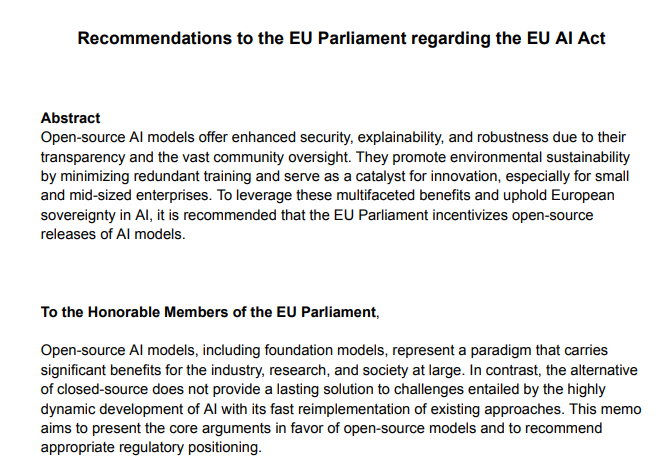
LAION has taken a proactive approach to advocate for EU regulations that support open-source AI. They have recently sent an open letter to the European Parliament, outlining the benefits of open-source models and proposing strategies to promote their adoption.
LAION’s Open Letter to the European Parliament
LAION’s open letter to the European Parliament highlights the advantages of open-source AI regarding safety, accountability, reproducibility, and robustness. The letter emphasizes the importance of transparency in AI and suggests that open-source models can address these concerns effectively. It also stresses the significance of open-source models in fostering innovation, especially in small and medium-sized enterprises.
Why LAION Encourages Open-Source AI Models
LAION believes open-source AI offers better safety, accountability, and reproducibility than closed-source models. The transparency of open-source models allows for extensive community review and early identification of security vulnerabilities. Open-source models also enable independent validation of AI results, ensuring trust and scientific integrity. LAION considers these factors pivotal for the advancement and widespread adoption of AI.
Motivating Factors Behind LAION’s Proposition
- Firstly, they acknowledge that compliance with complex regulatory requirements can be challenging for smaller companies and open-source movements.
- By endorsing open-source AI, LAION aims to provide a viable alternative that promotes innovation and growth in the AI sector.
- Additionally, LAION suggests incentivizing commercial companies to open-source their basic models while retaining ownership of fine-tuned versions, which can balance accessibility and commercial competitiveness.
The Benefits of Open-Source AI Models
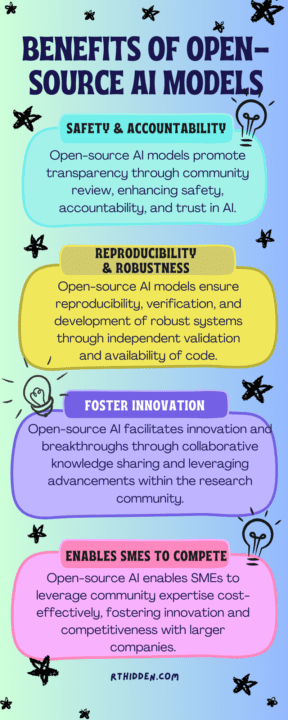
Open-source AI offers numerous benefits that contribute to advancing and democratizing AI research and development.
Safety and Accountability of Open Source AI Models
Open-source AI provides transparency, allowing for extensive community review and identifying potential security vulnerabilities. This transparency enhances the safety and accountability of AI, ensuring that it conforms to ethical and legal standards. By making the inner workings of AI accessible, open-source approaches promote a culture of responsibility and trust in the AI community.
Reproducibility and Robustness of Open-Source AI Models
Open-source models enable independent validation of AI results, ensuring reproducibility and scientific integrity. Researchers can study and replicate the experiments conducted with these models, facilitating the verification and refinement of AI techniques. Furthermore, the availability of open-source models fosters the development of robust and reliable AI systems that can withstand various real-world scenarios.
How Open Source Models Foster Innovation
Open-source AI fosters innovation by providing a collaborative environment where researchers can build upon existing work. Access to open-source models facilitates knowledge sharing, encourages exchanging ideas, and enables researchers to leverage each other’s advancements. This collaborative approach accelerates AI research and development, leading to breakthroughs and advancements that benefit the entire AI community.
LAION’s Protections for Small and Medium-Sized Enterprises
LAION recognizes the importance of supporting small and medium-sized enterprises (SMEs) in complying with AI regulations. They have proposed strategies to ensure SMEs can effectively leverage open-source AI.
How Open Source AI Models Benefit SMEs
Open-source AI provides SMEs with accessible and cost-effective tools to develop AI. By utilizing open-source models, SMEs can leverage the advancements and expertise of the AI community without substantial financial investments. This democratization of AI enables SMEs to compete with larger companies and drive innovation in their respective industries.
Challenges Faced by SMEs in Complying with AI Regulations
- Due to limited resources and expertise, SMEs often face challenges complying with AI regulations.
- Understanding and implementing complex regulatory requirements can be time-consuming and costly for SMEs.
- Additionally, the lack of access to proprietary AI can impede SMEs’ ability to develop AI solutions that meet regulatory standards.
LAION’s Proposed Strategies to Support SMEs
LAION proposes strategies to support SMEs in complying with AI regulations. They suggest regulators should focus on regulating AI applications rather than enabling technologies. This approach allows SMEs to leverage open-source AI without being burdened by complex regulatory requirements. Furthermore, LAION recommends incentivizing commercial companies to open-source their basic AI, providing SMEs with broader access to underlying technologies while allowing companies to maintain a competitive edge through fine-tuned versions.
Commercial Companies and Open-Source AI Models
The role of commercial companies in adopting and promoting open-source AI is crucial. LAION emphasizes the need for incentivizing commercial companies to embrace open-source approaches while maintaining their competitive edge.
Need for Incentivizing Commercial Companies to Go Open Source
Commercial companies play a significant role in AI research and development, often creating proprietary AI for industry-specific applications. LAION believes incentivizing these companies to open-source their basic models can lead to greater accessibility and collaboration in the community. By providing incentives, such as tax breaks or grants, commercial companies can be motivated to contribute to the open-source ecosystem while still maintaining their competitive advantage in specialized domains.
Maintaining a Competitive Edge While Promoting Transparency
Open-source AI promotes transparency and collaboration, but commercial companies may hesitate to reveal their proprietary technologies. LAION suggests a balanced approach where companies open-source their basic models while retaining ownership of fine-tuned versions for industry-specific applications. This strategy ensures companies can maintain their competitive edge while contributing to the open-source community.
Success and Failures of Open Source Approaches in the Industry
The industry has witnessed both success and failure in adopting open-source approaches to AI. Companies like Meta (formerly Facebook) have embraced open-source principles, making their models and tools publicly accessible. This approach has led to widespread adoption and collaboration within the community. However, other major AI technology companies such as Google, OpenAI, and Microsoft still adhere to the closed-source principle, limiting accessibility and collaboration. LAION encourages more companies to adopt open-source approaches, citing the benefits of transparency, accountability, and innovation.
LAION’s Newly Introduced OpenLM

LAION has recently introduced OpenLM, a new PyTorch codebase designed to enhance training efficiency for mid-sized language models.
Role of OpenLM in Efficient AI Training
OpenLM aims to address the challenges of training mid-sized language models efficiently. It is designed to utilize GPU fully, thereby increasing training speed and reducing computational overhead. OpenLM provides a versatile codebase that can be easily adapted to various research and development projects, facilitating the training with improved efficiency and performance.
This optimization allows for faster training times and more efficient use of computational power.
By maximizing the utilization of GPU, OpenLM enables researchers to train mid-sized language models effectively, enhancing the overall efficiency and productivity of training.
Comparative Performance of OpenLM and Other AI Models
LAION has tested the performance of OpenLM against other existing AI models. Through extensive training and evaluation, OpenLM has demonstrated superior performance in zero-shot text classification and multiple-choice tasks. Compared to other open-source alternatives, OpenLM has shown comparable performance to industry-leading models such as LLAMA-7B and MPT-7B. These results highlight the efficiency and effectiveness of OpenLM in training.
LAION’s Petition for an International Open-Source AI Supercomputer
In addition to promoting open-source AI, LAION has launched a petition to establish a publicly funded supercomputer dedicated to open-source AI research and development.
What the Petition Aims For
LAION’s petition aims to establish an international open-source AI supercomputer that supports research and development in the AI community. This publicly funded supercomputer would provide the necessary infrastructure for AI researchers to collaborate and develop advanced open-source AI. The petition seeks to ensure technological independence from large corporations and promote a transparent and inclusive AI ecosystem.
Public Response to LAION’s Petition
LAION’s petition has garnered significant public support, with thousands of individuals signing it. The response to the petition reflects the recognition of the importance of open-source AI research and the need for a publicly funded supercomputer to advance the field. The public’s response highlights the increasing interest in open-source AI and the desire for a more transparent and collaborative AI ecosystem.
Intended Impact on AI Research and Development
- The establishment of an international open-source AI supercomputer would have a significant impact on AI research and development.
- It would provide researchers with the necessary resources to develop advanced open-source models, tools, and datasets.
- The availability of such a platform would foster collaboration, promote innovation, and democratize access to AI.
- Additionally, the open nature of the supercomputer would support transparency and inclusivity in AI research, further advancing the field.
Technological Independence from Large Corporations
Technological independence is crucial for AI innovation, and LAION recognizes the challenges posed by dependence on significant technology corporations. They advocate for strategies that promote independence and foster a more diverse and collaborative AI ecosystem.
Challenges of Dependency on Large Tech Corporations
Dependency on large technology corporations can hinder innovation and limit accessibility to AI. These corporations often develop proprietary AI and technologies that might not be accessible to the broader community. SMEs and independent researchers may face challenges accessing these technologies, hindering their ability to compete and innovate in AI. Additionally, dependence on proprietary technologies limits collaboration and transparency in AI research and development.
Why Technological Independence is Vital for AI Innovation
Technological independence is vital for AI innovation, fostering collaboration, competition, and diversity in the AI ecosystem. LAION aims to create an environment where researchers can freely collaborate, access cutting-edge AI, and generate innovative solutions by promoting open-source AI models and tools. Technological independence allows for the development of diverse AI and approaches, leading to advancements that benefit the entire community.
How a Publicly Funded Supercomputer Could Promote Technological Independence
Establishing a publicly funded supercomputer dedicated to open-source AI research and development would promote technological independence. This supercomputer would reduce reliance on proprietary technologies developed by large corporations by providing researchers with access to state-of-the-art computing resources. It would empower researchers, SMEs, and independent developers to contribute to the community by developing innovative open-source models and solutions. Furthermore, the open nature of the supercomputer would encourage collaboration and knowledge sharing, fostering technological independence and driving AI innovation.
LAION’s Contributions to the Future of AI
LAION’s contributions extend beyond the development of open-source AI. They actively work towards democratizing AI research, promoting public engagement, and fostering international collaboration.
Democratizing AI Research Through Open Access
LAION democratizes AI research by providing open access to advanced AI models, tools, and datasets. By making these resources accessible to the public, LAION allows individuals and organizations to learn, experiment, and contribute to AI research and development. This democratic approach to AI fosters inclusivity and drives innovation by broadening participation in the field.
Promotion of Public Engagement and Awareness in AI
LAION recognizes the importance of public engagement and awareness of AI. They actively promote the understanding of AI technologies and their societal implications. Through various initiatives, such as public talks and educational programs, LAION aims to bridge the gap between AI experts and the general public, empowering individuals to make informed decisions and participate in AI discussions.
“democratizing AI research by providing open access to advanced AI models, tools, and datasets, fostering public engagement and awareness, and promoting international collaboration to create a transparent and inclusive AI ecosystem that benefits everyone.”
LAION.AI
Fostering International Collaboration in AI
LAION believes in the power of international collaboration in advancing AI research and development. They actively foster collaboration with researchers, organizations, and governments worldwide. LAION aims to create a global AI community that collaborates to solve complex challenges and drive AI innovation globally by promoting knowledge sharing, cooperative research projects, and open dialogue.
Effect of LAION’s Recommendations on the EU AI Regulations

LAION’s recommendations have the potential to significantly impact the EU AI regulations, addressing concerns regarding transparency, security, and innovation in AI.
Potential Impact on Transparency and Security in AI
LAION’s recommendations for using open-source AI promote transparency and accountability. By making the inner workings of AI accessible, open-source approaches enable extensive community review and early identification of security vulnerabilities. This increased transparency enhances the safety and security of AI, protecting against potential misuse and ensuring ethical and responsible AI practices.
Promotion of Innovation in the AI Sector
LAION’s emphasis on open-source AI fosters innovation by encouraging collaboration and knowledge sharing within the community. By making AI models and tools publicly accessible, LAION promotes the development of diverse and innovative solutions. These open-source approaches provide a platform for researchers, SMEs, and independent developers to contribute to the AI ecosystem, driving advancements and promoting healthy competition.
Expected Changes in AI Training and Development Practices
LAION’s contributions to AI research, including the introduction of OpenLM and the advocacy for open-source AI, are expected to change training and development practices. AI practitioners and researchers are likely to adopt open-source models and tools in their workflows, leveraging the benefits of transparency, accountability, and collaboration.
Additionally, publicly funded supercomputers dedicated to open-source AI research and development would provide researchers with the necessary infrastructure to innovate and develop advanced AI models. These changes would lead to a more open, inclusive, and efficient AI ecosystem.
Conclusion
LAION’s call for EU regulations to encourage open-source AI models is timely and essential. Open-source AI has the potential to revolutionize the field of AI, making it more accessible, inclusive, and transparent.
LAION’s petition has garnered significant public support, and it is clear that there is a growing demand for open-source AI. The EU has a unique opportunity to lead the way in regulating AI in a way that promotes innovation and benefits everyone.
Here are some of the critical benefits of open-source AI:
- Transparency and accountability: Open-source AI models can be scrutinized by anyone, which helps to ensure that they are safe, secure, and ethical.
- Collaboration and innovation: Open-source AI models foster collaboration and knowledge sharing, which can lead to faster and more innovative advances in the field.
- Accessibility and equity: Open-source AI models make AI more accessible to researchers, developers, and businesses of all sizes. This can help to level the playing field and promote equity in the AI ecosystem.
The EU AI Act is an opportunity to create a regulatory framework that supports open-source AI. The EU should consider exempting open-source AI models from specific regulations, such as those that impose high compliance costs. The EU should also provide funding and support for open-source AI research and development.
By encouraging open-source AI, the EU can help to create a more transparent, inclusive, and innovative AI ecosystem. This will benefit everyone, from individuals and businesses to society.
