Here’s some exciting news for all AI enthusiasts: you can now try DALL-E 3 in Bing’s Image Creator for free! This latest development allows users to get a sneak peek into the potential of DALL-E 3 before its official launch in ChatGPT Plus next month. With the ability to refine images, DALL-E 3 outperforms existing systems in following prompts. While its writing capabilities may not be perfect, this technology is a step forward. So, why not try it and see what amazing images you can create?
Introduction to DALL-E 3
What is DALL-E 3?
DALL-E 3 is the latest version of the DALL-E model developed by OpenAI. It is an artificial intelligence (AI) system that generates images from textual descriptions using deep learning techniques. DALL-E 3 takes text prompts as input and produces highly detailed and realistic images as output. It can create images that have never been seen before, pushing the boundaries of what AI can achieve regarding creativity and visual representation.
Why DALL-E 3 matters in AI’s evolution?
DALL-E 3 represents a significant milestone in the evolution of AI and its applications in image generation. It showcases the power of deep learning models in understanding and reproducing complex visual concepts from textual descriptions. This advancement has wide-ranging implications in various fields, including art, design, advertising, and entertainment, where high-quality visuals are essential. By improving the ability of AI to generate realistic and detailed images, DALL-E 3 opens up new possibilities for creative expression and automation.
DALL-E 3’s creators: OpenAI
DALL-E 3 was developed by OpenAI, a research organization focused on advancing AI technology safely and beneficially. OpenAI is known for its groundbreaking work in natural language processing and machine learning, including the development of the GPT series of models. With DALL-E 3, OpenAI continues to push the boundaries of AI capabilities and explore new frontiers in image generation and synthesis.
DALL-E 3’s attention to detail
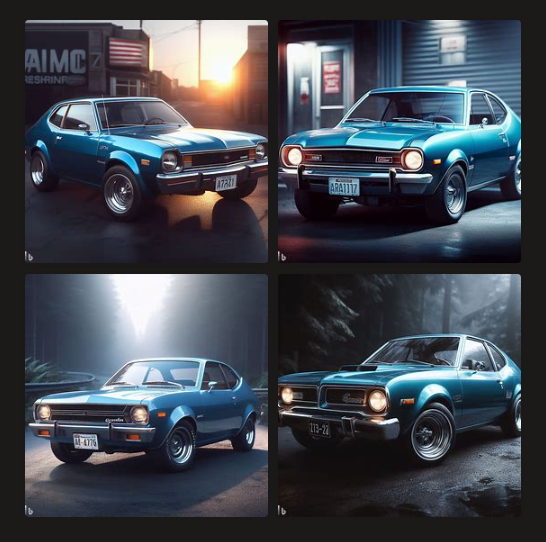
One of the standout features of DALL-E 3 is its incredible attention to detail when generating images. The model produces images that are not only visually impressive but also exhibit a level of fine-grained detail that is often difficult to achieve through traditional image-generation methods. This attention to detail is made possible by the large-scale training of DALL-E 3 on a vast dataset of images, allowing it to learn and capture subtle nuances in the visual world. The result is realism and fidelity that sets DALL-E 3 apart from existing image generation systems.
DALL-E 3 in Bing’s Image Creator
Bing’s Image Creator: Overview
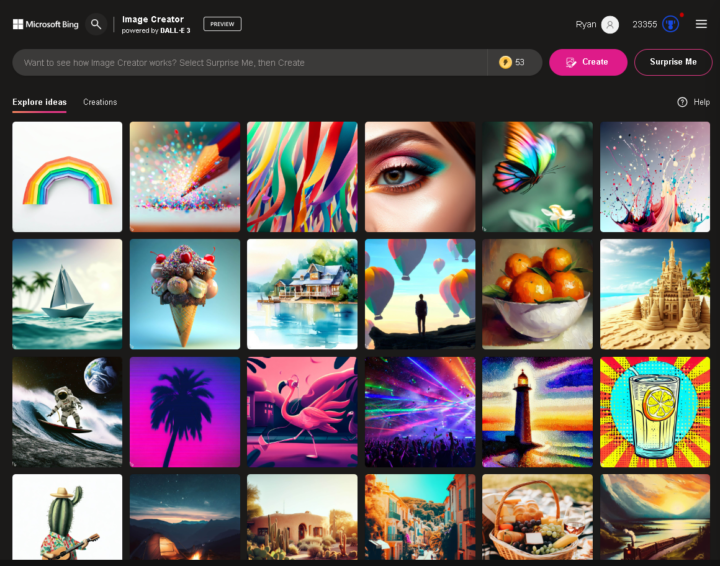
Bing’s Image Creator is a platform that allows users to create and modify images using AI-powered algorithms. It provides an intuitive interface for users to input text prompts and obtain corresponding visual outputs generated by AI models like DALL-E 3. Integrating DALL-E 3 into Bing’s Image Creator expands its capabilities and gives users a powerful image creation and manipulation tool.
How to access DALL-E 3 in Bing’s Image Creator?
Accessing DALL-E 3 in Bing’s Image Creator is simple and user-friendly. Users can navigate to the Image Creator section of Bing’s platform and find the option to use DALL-E 3. They can then input text prompts describing the desired image, and DALL-E 3 will generate corresponding visual outputs based on those prompts. This integration allows users to harness the power of DALL-E 3’s image generation capabilities directly within Bing’s Image Creator, enabling a seamless and intuitive image creation experience.
A hands-on preview of DALL-E 3 in Bing’s Image Creator
Users who have tried DALL-E 3 in Bing’s Image Creator have praised its performance and the quality of the generated images. The model demonstrates an impressive ability to accurately understand and interpret text prompts, resulting in images that align closely with the intended concepts and ideas. The generated images exhibit a high level of detail and fidelity, showcasing the advancements made by DALL-E 3 in image generation. Integrating DALL-E 3 into Bing’s Image Creator provides users a versatile and powerful tool for easily creating and modifying images.
Understanding the capabilities of DALL-E 3
Incredible attention to detail
DALL-E 3 has garnered attention for its exceptional attention to detail when generating images. The model has been trained on a massive dataset, allowing it to capture and reproduce intricate details in the visual world. Whether it is the fabric’s texture, the mirror’s reflection, or the nuanced lighting in a scene, DALL-E 3’s output images exhibit an impressive level of fidelity and realism. This attention to detail elevates the quality of the generated images and enhances their visual appeal.
Understanding prompts: An example
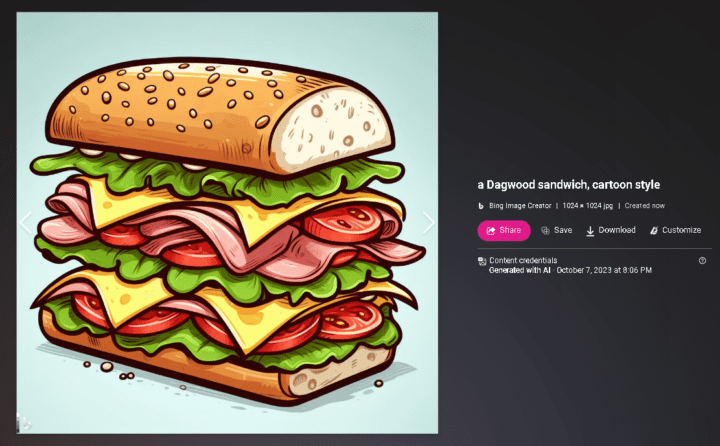
A key aspect of DALL-E 3’s functionality is its ability to understand and interpret textual prompts accurately. This means that users can describe the desired image through text, and DALL-E 3 will generate an image that aligns with the provided description. For example, a prompt describing “a picturesque sunset over a serene lake with mountains in the background” would produce an image that encapsulates the scene’s essence. This capability makes DALL-E 3 a valuable tool for artists, designers, and content creators who seek to bring their imaginative ideas to life through visuals.
Multiple outputs and variation generation
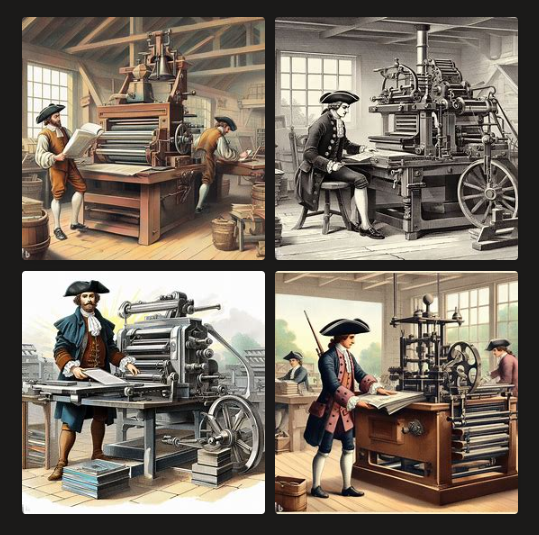
DALL-E 3 generates a single image based on a text prompt and can produce multiple outputs that capture different interpretations or variations of the given prompt. This versatility allows users to explore different visual possibilities and choose the image that best fits their needs or preferences. By offering a range of outputs, DALL-E 3 empowers users with greater creative freedom and flexibility in image generation.
The Role of AI in Bing’s Image Creator
AI’s integration with Bing’s Image Creator
Integrating AI, particularly DALL-E 3, with Bing’s Image Creator significantly enhances the platform’s capabilities and expands its potential applications. AI brings a level of automation and sophistication to image creation and manipulation that was previously unattainable. By leveraging AI’s ability to understand and process textual prompts, Bing’s Image Creator becomes a powerful tool for generating images that align with specific concepts or ideas. Integrating AI into Bing’s Image Creator streamlines the image creation process and enables users to achieve their desired visual outcomes more efficiently.
AI-powered image creation and refining
AI is crucial in creating and refining images within Bing’s Image Creator. With DALL-E 3, users can generate high-quality images accurately representing their desired concepts or ideas. Additionally, AI algorithms can refine and enhance existing images, allowing users to modify and customize visuals to suit their needs. Combining AI-powered image creation and refinement in Bing’s Image Creator empowers users to effortlessly create visually stunning and personalized content.
Comparison with existing systems
Advantages of DALL-E 3 over existing systems
DALL-E 3 offers several advantages over existing systems in image generation. One of the standout advantages is its remarkable attention to detail, which sets it apart from previous approaches. The realism and fidelity exhibited by DALL-E 3’s generated images surpass what existing systems can achieve. Furthermore, DALL-E 3’s ability to understand and interpret prompts accurately generates images that align closely with the desired concepts or ideas. This accuracy and alignment ensure that DALL-E 3’s outputs are more relevant and useful for users.
Limitations and room for improvement in DALL-E 3
While DALL-E 3 showcases significant advancements in image generation, it has limitations and areas for improvement. One limitation is the occasional inconsistency in the generated images, where different outputs may vary in quality or adherence to the given prompt. This variability can sometimes lead to less desirable results. Additionally, DALL-E 3 may struggle with complex or ambiguous prompts, resulting in less accurate or misleading outputs. OpenAI acknowledges these limitations and actively seeks user feedback to refine and improve DALL-E 3’s performance.
Integration of DALL-E 3 with ChatGPT
Upcoming launch in ChatGPT Plus
OpenAI has exciting plans to integrate DALL-E 3 into ChatGPT Plus, a subscription-based service that offers enhanced AI-powered chat capabilities. This integration will allow users to leverage the image generation capabilities of DALL-E 3 within the ChatGPT environment. OpenAI aims to provide users with a comprehensive and immersive chat experience by combining the power of text-based conversational AI with image generation. Users and AI enthusiasts alike eagerly anticipate the launch of DALL-E 3 in ChatGPT Plus.
Potential benefits of this integration
The integration of DALL-E 3 with ChatGPT Plus holds immense potential for various applications and user experiences. Users can interact with the AI model, describing their ideas or concepts through text, and receive visual representations of those ideas in real-time. This integration can empower artists and content creators to explore new avenues of creativity, enabling them to generate visual concepts and refine them through conversational interactions with AI. Additionally, users who rely on visual communication will benefit from this integration as they can now easily convey their ideas through images, even if they lack the necessary artistic skills.
Potential implications and uses of DALL-E 3
Implications for artists and content creators
DALL-E 3 has significant implications for artists and content creators, offering them a powerful visual expression and creation tool. Artists can use AI-generated images as inspiration, incorporating them into their artistic process or as references for their own work. Content creators, on the other hand, can leverage DALL-E 3 to generate visuals for marketing materials, social media posts, and website design, among other applications. The versatility and quality of the generated images can significantly enhance the visual appeal and effectiveness of their content.
AI’s role in future image editing and creation
The development and integration of AI models like DALL-E 3 in image editing and creation tools signal a transformative shift in the industry. AI has the potential to streamline and automate various aspects of the creative process, from ideation to refinement. As AI models continue to improve, we can expect increased reliance on these tools by artists, designers, marketers, and other professionals. AI’s ability to understand and interpret textual prompts and generate visual outputs will become an invaluable asset in the creative industry, enabling faster and more efficient content creation while maintaining high quality and artistic expression.
Community involvement and feedback
Engaging with the DECODER community
OpenAI recognizes the importance of community involvement and seeks to actively engage with users, developers, and the broader AI community to gather feedback and insights. The DECODER community, which includes individuals from various disciplines, such as AI researchers, artists, and technology enthusiasts, provides a platform for discussions, sharing experiences, and exchanging ideas. OpenAI encourages community members to provide feedback on their experiences with DALL-E 3, enabling them to iterate and improve the model based on real-world usage and user input.
Expected feedback and discussions on DALL-E 3
As with any AI model, it is anticipated that there will be diverse feedback and discussions surrounding DALL-E 3. Users may provide insights into the strengths and weaknesses of the model, propose use cases or applications that they find particularly valuable, or share suggestions for improvement. Researchers and enthusiasts may discuss the underlying technology and the potential implications of DALL-E 3 in the broader AI landscape. OpenAI welcomes these discussions and anticipates a vibrant and dynamic community-driven exploration of DALL-E 3’s capabilities and potential.
Supporting the development of DALL-E 3


How to support ongoing AI research and development
Supporting ongoing AI research and development, including advancing models like DALL-E 3, is crucial for progress in the field. There are several ways individuals and organizations can contribute and support these efforts. One way is to provide feedback and share experiences with the AI models’ creators, helping them understand real-world use cases and uncover areas for improvement. Additionally, financial support through donations or grants enables research organizations like OpenAI to allocate the necessary resources to continue pushing the boundaries of AI technology. Lastly, active participation in AI communities and discussions fosters a collaborative environment that fuels innovation and drives the field forward.
Benefits of supporting AI development
Supporting AI development offers numerous benefits that extend beyond the immediate advancements in technology. By contributing to AI research and development, individuals and organizations play an active role in shaping the future of artificial intelligence. They contribute to the creation of sophisticated models like DALL-E 3 that have the potential to revolutionize various industries and improve the lives of individuals worldwide. Additionally, supporting AI development fosters a culture of innovation, collaboration, and knowledge sharing, driving progress and creating new opportunities for societal and economic growth.
Future of AI and image creation
Expected advancements in AI-powered image generation
The future of AI-powered image generation is filled with exciting possibilities and expected advancements. As AI models evolve, we can anticipate improvements in their ability to generate highly realistic and nuanced images. This includes advances in detail, fidelity, and artistic expression exhibited by the generated visuals. Furthermore, integrating AI models with advanced editing and manipulation tools will give users greater control and flexibility in customized image creation. As AI research progresses and new techniques emerge, we can expect AI-powered image generation to become an indispensable tool for artists, designers, and content creators.
Predictions for future AI capabilities in imaging
Looking ahead, it is reasonable to predict that AI’s capabilities in imaging will expand beyond static images into other domains, such as video generation and animation. AI models equipped to understand and synthesize visual concepts could revolutionize the animation industry, enabling the rapid creation of high-quality animated content. Additionally, AI could significantly enhance virtual and augmented reality experiences, generating immersive and realistic visuals that blur the lines between the real and virtual worlds. The future of AI in imaging holds immense potential, and it is an area that will continue to witness significant advancements and innovations.
