
China proposes new rules and guidelines for managing generative AI services. At the same time, researchers developed AI models that combine natural language understanding with code, and Baidu introduced its enhanced generative AI model, Ernie 4.0. All that and more in today’s edition of Hidden AI News Daily.
Lemur and Lemur Chat: Evolving AI with Natural Language and Code Understanding
Researchers from the University of Hong Kong, Salesforce, University of Washington, and MIT CSL have collaborated to develop Lemur and Lemur Chat. These AI models combine natural language understanding with code. These models have shown impressive performance on various text and code benchmarks.
The researchers aimed to create advanced language agents to understand human and programming languages. Integrating code into the model, lemur, and lemur chat have demonstrated improved capabilities in tasks such as code summarization, semantic parsing, and program synthesis.
On several benchmarks, the team compared their models against other open-source models like GPT-3. The results showed that lemur outperformed these models on tasks like semantic parsing accuracy and code generation quality. Additionally, for agent abilities, lemur chat narrowed the gap with popular closed-source models like ChatGPT and PALM.
This research is a significant step towards developing AI systems that can seamlessly interact with developers through natural language interfaces while understanding code semantics.
BAIDU Advances AI With Enhanced ERNIE 4.0 and Expanded Product Integration
Baidu continues to make significant strides in artificial intelligence by introducing and expanding its various offerings. Recently, at the Baidu World Conference, Baidu introduced its latest generative AI model, Ernie 4.0. This improved version incorporates enhancements that compete with OpenAI’s GPT-4 model on several benchmarks.
Ernie 4.0 demonstrated enhanced comprehension, generation, reasoning, and memory abilities across various domains, such as trip planning, artwork creation, and solving geometry problems. It showed an improved grasp of nuance and subtext in conversation compared to its predecessors.
With a performance boost of roughly 30%, Ernie 4.0 brings significant advancements to natural language processing tasks. This model primarily focuses on Mandarin but also aids English interactions.
Ernie 4.0 is accessible by invitation only but will soon be extended to enterprise clients and the public. It will be integrated into several of Baidu’s products, including Baidu Search, Baidu Maps, Baidu Drive, and workplace applications such as InfoFlow and Wenku.
But Baidu’s advancements in AI don’t stop with Ernie 4.0. The company is also expanding its AI capabilities across various additional offerings. Baidu’s generative AI strategy includes tools like Baidu Wenku Smart Writer and Baidu InfoFlow Smart Video Maker, both powered by AI.
This expanded AI integration has applications across various domains. Baidu Search will provide an intelligent search engine that efficiently understands natural language queries and retrieves relevant information. Similarly, Baidu Drive will feature advancements such as voice-controlled navigation and personalized suggestions based on user preferences. Meanwhile, Baidu Maps will leverage AI technologies to optimize routes for user convenience.
These recent advancements reflect Baidu’s ambition to build a robust AI ecosystem amid competition from local rivals like Alibaba and Huawei. Despite these challenges, Baidu remains committed to contributing to economic growth by providing innovative solutions that enhance user experiences across different domains.
China Proposes New Rules for Managing Generative AI Services
China has proposed new rules and guidelines for managing generative AI services. These regulations aim to ensure the responsible development and deployment of artificial intelligence technology while addressing potential risks.
These rules involve registration requirements for organizations providing generative AI services. This step promotes accountability among service providers by establishing a record of their activities.
Additionally, China has implemented a block-list system that bans certain training sources used by generative AI models. The goal is to prevent the generation of harmful or illegal content by restricting access to problematic datasets.
Furthermore, China has introduced the Beijing AI principles, emphasizing respect for human rights, fairness, and transparency in AI development. These principles serve as guidelines for generative AI research and development organizations.
These rules and guidelines reflect China’s commitment to responsible AI development and recognition of ethical considerations’ importance in this rapidly advancing field.
Austin: Advancing AI
The Austin Forum on Technology & Society
The Austin Forum on Technology & Society is a monthly event in Austin, Texas, which brings together expert speakers to discuss several topics, including AI, Quantum Computing, 3D Printing, and more. The event was initially aimed at people and companies in Austin, but it gained followers worldwide through online streaming during the pandemic.
Austin is known for its vibrant tech community, creativity, positivity, and startup ecosystem. While large tech companies like Dell, IBM, Oracle, Tesla, Apple, Google, and Facebook have a significant presence in Austin, the city is still more known for its startup mindset.
Currently set to grow rapidly in AI advancements with an upcoming Austin AI ecosystem initiative, this aims to bring companies together to advance the state of AI. Health Tech & biotech are also other areas where Austin is making big strides. There is potential for further success regarding the intersection of AI and health Tech.
Lauren Lera on the Impact of AI on the Job Market
At the Austin Forum on Technology & Society, recruitment practices were discussed by Lauren Lera from technical research technical recruiting at Netflix. They spoke about how AI impacts the job market and recruiting practices.
AI is being used to analyze applications and match keywords, which can be advantageous, but there are disadvantages, too, such as biased automated interviews.
Some recruiters like using AI for sourcing strategies but have concerns about automated interviews due to biases in automated screening. It’s especially important to tackle this issue as diversity & inclusion should be promoted within firms across industries.
Lauren Lera advocates considering non-traditional factors when evaluating candidates, such as educational background, since a historically diverse pool has been limited, so fostering talent from untraditional backgrounds will help promote diversity.
In a year or so, they may discuss future recruiting advancements caused by the growth of AI skills becoming increasingly important within the tech industry.
People working within the industry gain AI skills daily; hence, breaking into tech without AI skills may be challenging. It is necessary to teach those not in tech about AI.
The need for AI skills will continue to grow as technology evolves rapidly.
Chuck Martin Interviews Sanikesh Casturi from American Airlines
In an interview with Sanikesh Casturi from American Airlines at the Austin Forum on Technology & Society, generative AI and its potential applications were discussed.
Generative AI evolves with new applications and models, such as GPT-1, GPT-3, and ChatGPT-4. The potential for generative AI in various industries is vast, but there are concerns regarding bias, interpretability, and fake data.
Sanikesh believes that generative AI can be adopted in the finance, security, retail, healthcare, and education sectors within 5-10 years. To stay ahead of the field, he reads articles and research while listening to keynote sessions from other data scientists.
In the airline industry, specifically, data science plays a role in operations management & understanding customer preferences. Generative AI can enhance customer experience through chatbots and optimize business operations.
However, adopting generative AI may take time due to ethical considerations & framework development, especially regarding issues like biases embedded within these systems.
For example, call centers can benefit since chatbots can provide more convincing answers to customer queries, making them feel like they’re interacting with humans rather than just automated bots.
Informa Group Director RajaT KOTRA on Impact of AI
Rajat Kotra from Informa Group discussed the impact of AI across industries during an interview at the Austin Forum on Technology & Society.
AI has existed since 2009-2010 but gained more traction after IBM’s Watson won Jeopardy! in 2011. Initially focused on academics rather than real business value, AI has exploded in use cases over the past 10 years, with 3,400 use cases implemented or experimented with.
New techniques in AI, such as reinforcement learning and unsupervised learning, have become mainstream. AI has democratized data science, making it accessible to general business practitioners. Generative AI has brought AI into day-to-day business discussions.
The journey of AI is ongoing, and the final destination is yet to be defined. Rajat believes that the focus should be on business applications and use cases rather than the concept of artificial general intelligence.
Ethics in AI are improving over time, but they are still challenging regarding transparency & bias.
Diffusers: The Ultimate Image Generator
Stable Diffusion: A powerful generative modeling technique

Stable Diffusion is a powerful generative modeling technique that enables users to create high-quality images by iteratively refining random noise inputs. It is based on diffusion, which involves gradually spreading information or heat across a system.
There are various methods available for running Stable Diffusion models. One recommended option is Paperspace Notebooks due to their versatility and variety of machine offerings. Another option is using Diffusers, a package developed by Runway ML, CompVis, and HuggingFace for generating images with Stable Diffusion in a Jupyter Notebook environment. Diffusers can be easily installed using the command pip install --upgrade diffusers[torch].
When working with Stable Diffusion, users control parameters such as prompt, height, width, num_inference_steps, guidance_scale, negative_prompt, num_images_per_prompt, eta, and generator. These parameters can be adjusted to achieve the desired image generation results.
Additionally, there are other methods available for generating images with Stable Diffusion. The ComfyUI and AUTOMATIC1111 Stable Diffusion Web UIs provide user-friendly interfaces for interacting with Stable Diffusion models. The Fast Stable Diffusion project by TheLastBen is another recommended serving application that offers efficient image generation on Paperspace.
Users can optimize expense rates by utilizing different hardware offerings on Paperspace while still achieving high-quality outputs.
ScaleCrafter: A solution for higher-resolution visual generation
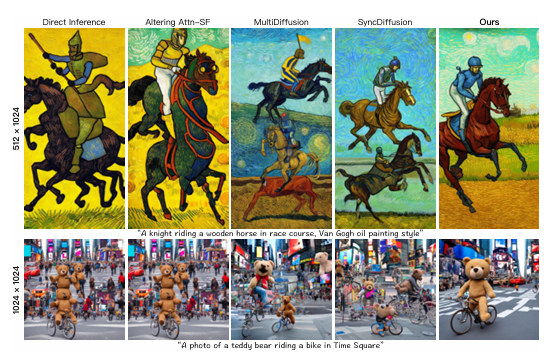
Generating high-resolution images has challenged existing methods due to problems like object repetition and deformed object architectures. However, ScaleCrafter proposes a solution to address these issues in higher-resolution visual generation.
ScaleCrafter uses re-dilation to adjust the convolutional perceptual field of the U-Net architecture dynamically. This adjustment effectively allows the model to handle greater resolutions without additional training or optimization stages. With ScaleCrafter, ultra-high-resolution photographs up to 4096×4096 pixels can be generated.
Comprehensive tests have shown that ScaleCrafter successfully addresses the object repetition issue and improves high-resolution image synthesis. This method can be applied not only to text-to-image models but also to text-to-video models and different iterations of Stable Diffusion.
Microsoft Introduces 365 Copilot: The AI Assistant for Your Business
Microsoft recently unveiled its latest addition to the world of artificial intelligence, the 365 Copilot. This innovative AI assistant is designed to revolutionize our work by taking on various tasks and representing users in meetings. Integrated into Microsoft’s suite of office applications, Copilot aims to streamline productivity and enhance collaboration.
Starting November 1st, users can access this powerful tool to summarize Teams meetings. With Copilot, you no longer must worry about missing important discussions or forgetting key details. It acts as your virtual assistant, ensuring you stay informed even when you can’t attend an in-person meeting.
But that’s not all! Copilot goes beyond just meeting summaries. It assists in drafting emails, composing documents, and creating presentations. Imagine having an AI-powered writing partner who can help you create compelling content and save time.
Built on the same technology as chat GPT (Generative Pre-trained Transformer), Copilot has been trained extensively to understand natural language and generate human-like responses. This means that it can engage in conversations with you, making it feel like you’re working side by side with a real person.
One of the key concerns surrounding AI assistants like Copilot is the potential phasing out of human workers and over-reliance on automation. While it’s true that these technologies may impact certain administrative roles, they also have tremendous potential to augment human capabilities rather than replace them entirely.
Regulations around AI disclosure is another topic of discussion regarding tools like Copilot. The European Union has emphasized the importance of transparency and disclosure when interacting with AI systems, particularly those used for critical decision-making processes. As we continue to embrace these advancements, it will be crucial for organizations using such technologies to ensure compliance with ethical guidelines and regulations.
Copilot is designed with security in mind, allowing it to access personal or company data securely. This ensures that your confidential information remains protected while benefiting from the assistant’s capabilities. Microsoft aims to provide a secure environment for users by using state-of-the-art encryption and authentication measures.
So, what can the co-pilot do? Let’s take a closer look at some of its features:
- Email Assistance: Copilot can help you draft emails by suggesting responses based on the context of the conversation. It can even condense a lengthy email thread and propose a response that captures the key points.
- Document Composition: Need help writing that important report? Copilot can assist you in composing documents by offering suggestions for content and structure. It uses its vast knowledge base to generate relevant ideas, helping you create high-quality documents efficiently.
- Presentation Creation: Creating presentations can be time-consuming, but it becomes a breeze with a Copilot. In just 43 seconds, the Copilot can generate a PowerPoint presentation complete with slides and even provide you with a script to guide your delivery.
- Meeting Insights: Ever find yourself struggling to keep up with all the discussions during team meetings? Copilot has your back! It can pinpoint discussion themes in Microsoft Teams meetings, making it easier for you to follow along and contribute effectively.
It’s important to note that while the Copilot provides valuable insights into meeting discussions, it does not identify individual performances or track attendance. This ensures privacy and avoids potential biases or discrimination based on AI-generated assessments.
To access Copilot’s capabilities online, users will need a monthly subscription. While this may raise concerns about dependency on AI tools and the potential pitfalls of relying too heavily on automation, it also presents an opportunity for organizations to optimize their workflows and free up valuable time for employees to focus on more strategic tasks.

Thank you for reading Hidden AI News Daily
Thank you for reading Hidden AI News Daily! Remember, this newsletter is released daily to keep you up-to-date on AI and technology news. Your feedback is important to us, so please provide it in the mobile app to help us improve this newsletter. Stay tuned for more exciting content tomorrow!
