
Greetings, readers, and welcome to my article on brainstorming content for your buyer’s journey. I constantly strive to create targeted content that engages and converts my audience. In this article, I will share my insights and strategies for developing an effective content marketing plan that aligns with your buyer’s journey.
Before we dive in, let’s first define what the buyer’s journey is. The buyer’s journey is the process buyers go through before making a purchase, and it consists of three stages; awareness, consideration, and decision-making. Each stage requires unique content that satisfies the buyer’s needs and influences their decision-making process.
Now, let’s talk about brainstorming and its crucial role in developing an effective content marketing strategy. Brainstorming is the process of generating ideas and solutions through unstructured and creative thinking. In the context of content creation, it involves coming up with content ideas that align with the buyer’s journey and address their pain points and needs.
Key Takeaways:
- The buyer’s journey consists of three stages: awareness, consideration, and decision-making.
- Each stage requires unique content that aligns with the buyer’s needs and influences their decision-making process.
- Brainstorming is a crucial component of a successful content marketing strategy.
- It involves generating content ideas that address the buyer’s pain points and needs.
Understanding the Buyer’s Journey
Before we start brainstorming content ideas for the buyer’s journey, it’s important to understand what the buyer’s journey is and why it matters. The buyer’s journey is the process that a potential customer goes through before making a purchase. It consists of three main stages: awareness, consideration, and decision-making. During each stage, the buyer has different needs and priorities, and requires different types of content to guide them through their journey.
At the awareness stage, the buyer is just beginning to research solutions to their problem or need. They are looking for educational content that will help them understand their situation better. For example, if they are looking for a new car, they may be looking for articles on car reviews, car safety, and car maintenance.
During the consideration stage, the buyer has narrowed down their options and is looking for more specific information about the products or services they are considering. They are looking for content that provides more details about features and benefits, as well as comparisons with similar products. For example, if they have decided they are interested in a specific car, they may be looking for reviews that compare it to other cars in its class.
Finally, during the decision-making stage, the buyer is ready to make a purchase. They are looking for content that will help them make a final decision, such as pricing information, financing options, and customer reviews. For example, they may be looking for the best deals on the car they have chosen, or for testimonials from other customers who have purchased the same car.
The Importance of Understanding Your Buyer Persona
In order to create effective content for each stage of the buyer’s journey, it’s important to understand your buyer persona. A buyer persona is a fictional representation of your ideal customer, based on market research and data about your existing customers. Understanding your buyer persona can help you create content that is tailored to their needs and preferences, and that will resonate with them.
When developing a buyer persona, consider factors such as age, gender, income, education level, and interests. You can also use data analytics to gain insights into their online behavior, such as the types of content they engage with and the social media platforms they use.
By understanding your buyer persona, you can create content that speaks directly to their needs and desires at each stage of the buyer’s journey, increasing the chances of a successful conversion.
Mapping the Buyer’s Journey
Mapping the buyer’s journey is critical to creating a successful content marketing strategy. The process involves developing a visual representation of your buyers’ journey from awareness to decision-making. By creating a map, you can identify touchpoints and define content needs for each stage of the journey, ensuring that your content aligns with your buyer’s decision-making process.
To develop a buyer’s journey map, follow these steps:
- Identify the different stages of the journey. The buyer’s journey typically includes three main stages: awareness, consideration, and decision-making.
- Define the touchpoints at each stage. Touchpoints are the interactions that buyers have with your brand during the journey. This could include browsing your website, attending a webinar, or speaking with a sales representative.
- Identify the content needs for each touchpoint. Determine the type of content that will be most effective at each stage of the journey. For example, informative blog posts and social media content may be most effective at the awareness stage. In contrast, product demos and case studies may be more effective at the decision-making stage.
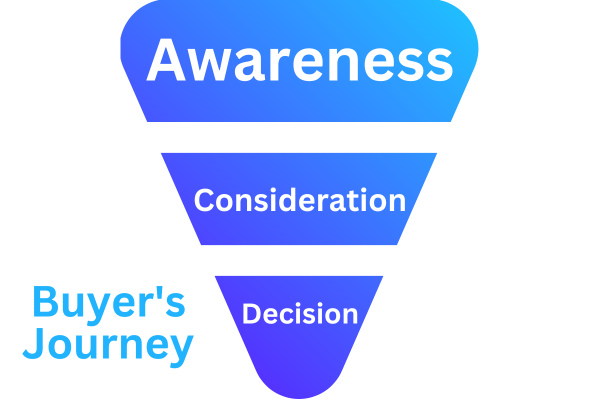
- Create a content funnel. The content funnel is a visual representation of the buyer’s journey, with different types of content mapped to each stage. The top of the funnel represents the awareness stage, the middle represents the consideration stage, and the bottom represents the decision-making stage.
Tip: When developing your content funnel, keep in mind that buyers at each stage have different needs and preferences. For example, those in the awareness stage may need educational content, while those in the decision-making stage may need more detailed product information.
Check out this example of a content funnel:
Understanding Your Audience
Before diving into content ideation, it’s crucial to understand your audience and their needs. One effective way to develop this understanding is by creating buyer personas. These are fictional representations of your ideal customers, based on real data and insights.
To create accurate buyer personas, conduct market research, analyze your existing customer base, and use data analytics tools to gain insights into your target audience. Some key information to include in your buyer personas are demographics, goals and challenges, pain points, and preferred communication channels.
Once you have a solid understanding of your audience, you can begin tailoring your content to meet their needs and preferences. This will result in more targeted and effective content that resonates with your audience, and ultimately drives conversions.

Brainstorming Techniques for Content Ideation
Brainstorming is a powerful tool for generating fresh and innovative ideas. When it comes to content marketing, brainstorming can help you come up with impactful content ideas that resonate with your audience and guide them through the buyer’s journey.
Here are some effective brainstorming techniques you can use to ideate content for each stage of the buyer’s journey:
Mind mapping
Mind mapping is a visual brainstorming technique that helps you organize your thoughts and ideas. Start by identifying a central topic, such as a buyer persona or a stage in the buyer’s journey. Then, brainstorm related ideas and themes, and connect them to the central topic using lines and arrows. Use colors and images to make your mind map more engaging and memorable.

The 5 Whys technique
The 5 Whys technique involves asking a series of “why” questions to get to the root of a problem or challenge. Apply this technique to content ideation by starting with a broad topic, such as “awareness stage content”, and asking “why” questions to narrow down your focus and generate specific content ideas. For example:
- Why is awareness stage content important? To educate prospects about their pain points and needs.
- Why do prospects need education? So they can make informed decisions about potential solutions.
- Why do prospects need solutions? To address their pain points and achieve their goals.
- Why do prospects choose one solution over another? Because it aligns with their values and priorities.
- Why is it important to align content with values and priorities? So prospects feel understood and connected to your brand.
SWOT analysis
SWOT analysis is a strategic planning tool that helps you identify your strengths, weaknesses, opportunities, and threats. Use this technique to ideate content by identifying a buyer persona or stage in the buyer’s journey, and brainstorming content ideas that leverage your strengths, address your weaknesses, capitalize on opportunities, and mitigate threats. For example:
| Strengths | Weaknesses |
|---|---|
| Expertise in industry trends and best practices | Limited budget for content creation |
| Proven track record of success with clients | Low brand awareness among target audience |
| Opportunities | Threats |
|---|---|
| Increasing demand for solutions in target market | Emerging competitors with similar offerings |
| New channels for content distribution and promotion | Shifting buyer preferences and behaviors |
By using these brainstorming techniques, you can generate a wealth of content ideas that resonate with your audience and guide them through the buyer’s journey. Remember to align your content with your buyer persona and their needs, and to optimize it for maximum engagement and impact.
Developing a Content Strategy
Once you have a clear understanding of your audience and their needs, it’s time to develop a comprehensive content marketing strategy. Your strategy should align with the buyer’s journey and guide your content creation efforts. Here are the key elements of a successful content marketing strategy:
| Element | Description |
|---|---|
| Goal setting | Define the goals and objectives of your content marketing efforts. Your goals should be specific, measurable, and aligned with business objectives. |
| Defining key performance indicators (KPIs) | Identify the metrics you will use to measure the success of your content marketing strategy. KPIs may include website traffic, engagement metrics, conversion rates, and social media metrics. |
| Creating a content calendar | Develop a plan for creating and publishing content that aligns with the buyer’s journey. Your content calendar should include topics, formats, publishing dates, and distribution channels. |
| Aligning content with the buyer’s journey | Ensure that your content is targeted to meet the needs and preferences of your audience at each stage of the buyer’s journey. Use the insights gained from the buyer persona development and user research to inform your content creation efforts. Aim to create a seamless experience for your customers across all touchpoints. |
| Developing a content distribution plan | Identify the channels and tactics you will use to distribute your content and reach your target audience. Your distribution plan may include social media, email marketing, paid advertising, and influencer outreach. |
By implementing these elements in your content marketing strategy, you will be able to develop a plan that aligns with your business goals and engages your target audience at each stage of the buyer’s journey. Remember to constantly measure the success of your efforts and make necessary adjustments to optimize your content marketing strategy.

Creating Targeted Content for Each Stage
Now that we have mapped out the buyer’s journey and identified the content needs for each stage, it’s time to create targeted content that resonates with our audience. Remember, the goal of content creation is to provide value and guide the buyer through their journey towards making a purchase decision.
To create effective content, we need to tailor our messaging to meet the needs and preferences of our target audience at each stage. Let’s take a look at the different types of content that work best at each stage:
| Stage | Types of Content |
|---|---|
| Awareness |
|
| Consideration |
|
| Decision-making |
|
It’s essential to keep in mind that every piece of content we create should align with our buyer personas and address their pain points. By doing so, we can develop a deeper connection with our audience and ultimately convert them into customers.
For instance, if we’re targeting the awareness stage, we can create blog posts that answer frequently asked questions (FAQs) related to our industry. Additionally, we can use visually appealing infographics to provide an overview of our products or services and highlight how they can benefit the customer.

Visual aids such as infographics are a great way to simplify complex information and engage our audience.
On the other hand, if we’re targeting the decision-making stage, we can use customer testimonials to build trust and provide social proof. Additionally, we can offer free trials and pricing details to help the customer make an informed decision.
Ultimately, the key to successful content creation is to understand our target audience, identify their pain points and create content that provides value and builds trust. By doing so, we can guide our customers through the buyer’s journey and towards a purchase decision.
Optimizing Content for Buyer Engagement
In order to maximize engagement with your content and ultimately guide buyers through their journey, it’s crucial to optimize your content. This means making sure your content is not only relevant and informative but also visually appealing and easy to navigate. Here are some tips on how to optimize your content:
| Technique | Explanation |
|---|---|
| Search Engine Optimization (SEO) | By optimizing your content for search engines, you increase the chances of your content being found by potential buyers. This includes using relevant keywords, creating descriptive meta tags, and optimizing your headlines and subheadings. |
| Compelling Headlines and Calls to Action (CTAs) | Your headlines and CTAs should grab the reader’s attention and encourage them to take action. This can include using action-oriented language and creating a sense of urgency. |
| Visuals and Multimedia Elements | Visuals such as images, videos, and infographics can help break up long blocks of text and make your content more engaging. They can also help illustrate complex concepts and make your content more memorable. |
It’s also important to measure the effectiveness of your content and make necessary adjustments. This can include analyzing engagement metrics such as time on page, bounce rates, and social shares. By paying attention to what’s working and what’s not, you can optimize your content and improve its impact on the buyer’s journey.

Remember, optimizing your content is an ongoing process. By staying up to date with industry trends and regularly assessing the effectiveness of your content, you can continuously improve your content marketing strategy and guide buyers through their journey with ease.
Leveraging Social Media for Content Distribution
Social media has become an integral part of any content marketing strategy. With millions of active users on various social media platforms, it provides a vast opportunity to reach your target audience and engage with them. However, it is essential to understand the best practices for leveraging social media for content distribution.
Firstly, it is crucial to identify the social media platforms that your target audience is most active on. Depending on your target audience and industry, you may find that certain platforms are more effective than others. For example, if your target audience is predominantly professionals, LinkedIn may be a better platform for content distribution than Instagram.
When sharing content on social media, it is important to create shareable content that resonates with your audience. This can include visually engaging content such as infographics, images, and videos. Including relevant hashtags can also help increase the reach of your posts.
Engaging with your audience on social media can also help boost engagement. Responding to comments and messages can help establish relationships with your audience and encourage them to engage further with your content.
Finally, using analytics to measure the performance of your social media strategy is critical. This can provide insights into which types of content and platforms are most effective in reaching and engaging with your target audience. You can use this data to refine your strategy and optimize your content for better results.

When used effectively, social media can be a powerful tool for content distribution, reaching and engaging with your target audience. By creating shareable content, engaging with your audience, and measuring your performance, you can maximize the impact of your social media strategy and enhance your content marketing efforts.
Incorporating User-generated Content
One of the most effective ways to enhance your content marketing strategy is to incorporate user-generated content (UGC). UGC refers to any content created by your audience, such as reviews, testimonials, social media posts, and videos. By leveraging UGC, you can boost engagement, authenticity, and trust with your target audience.
When it comes to UGC, there are a few key things to keep in mind. First, encourage your audience to create and share UGC by offering incentives or running contests. This can help generate a steady stream of content to choose from. Second, be sure to curate and repurpose UGC effectively. Choose content that aligns with your brand and resonates with your target audience. Use tools like Feedly or Buzzsumo to find relevant content or look to your social media accounts for inspiration.
| Tip: | Don’t be afraid to get creative with UGC! You can incorporate it into blog posts, social media campaigns, or even product descriptions. Just be sure to get permission from the original creator and give credit where credit is due. |
|---|
Finally, when incorporating UGC into the buyer’s journey, think about how it can enhance each stage. For example, in the awareness stage, you could showcase user-generated images or videos of your product to grab attention. In the consideration stage, you could share customer reviews or testimonials to build trust. And in the decision-making stage, you could highlight social proof, such as the number of likes or shares a piece of content has received.

Overall, incorporating UGC into your content marketing strategy can be a powerful way to engage your audience and build trust. By following these tips and exploring creative ways to incorporate UGC, you can create a seamless and effective experience for your customers throughout the buyer’s journey.
Measuring Success and Making Adjustments
After creating targeted content for each stage of the buyer’s journey and optimizing it for engagement and distribution, it’s important to measure your content marketing efforts’ success.
One metric to track is website traffic, which can measure the number of visitors to your site and pages and the sources that led them there. Conversion rates are another key metric to track, which measures the percentage of visitors who took a specific action, such as filling out a form or making a purchase. Engagement metrics can also provide valuable insights, including social media shares, comments, and likes.
Using these metrics, you can determine which pieces of content are most effective and adjust your content strategy accordingly. For example, if a certain type of content consistently generates high engagement, consider creating more of it, or if a particular channel is underperforming, allocate more resources to other channels that are seeing more success.
It’s important to remember that measuring success and making adjustments is an ongoing process. Continuously monitoring your content’s effectiveness can help you stay ahead of the curve and improve your content marketing strategy over time.
Ultimately, creating targeted, optimized content that aligns with the buyer’s journey is essential for driving engagement and conversions from your target audience. By understanding the different stages of the buyer’s journey and leveraging a variety of content types and channels, you can build a comprehensive content marketing strategy that generates tangible results.

Conclusion
Creating targeted content for the buyer’s journey is crucial for any successful content marketing strategy. By understanding your audience and mapping out their journey, you can develop a comprehensive content plan that meets their needs and preferences at each stage.
Brainstorming techniques, such as mind mapping and SWOT analysis, can help generate creative ideas for content creation. Developing a content strategy with clear goals, key performance indicators, and a content calendar is also vital for success.
Creating various types of content, optimized for engagement, and distributed effectively through social media and other platforms can also enhance the buyer’s journey. Incorporating user-generated content can also boost authenticity and engagement.
Measuring the success of your content marketing efforts is essential for making necessary adjustments. By tracking key metrics and using insights to adapt, you can continually improve your strategy and deliver a seamless experience for your customers.
Thank you for reading!
FAQ
Q: Why is brainstorming content important for the buyer’s journey?
A: Brainstorming content is crucial for the buyer’s journey because it allows you to create targeted content for each stage, from awareness to decision-making. By brainstorming, you can generate ideas that resonate with your audience and guide them through the buying process.
Q: What is the buyer’s journey?
A: The buyer’s journey refers to the process that a potential customer goes through from the moment they become aware of a problem or need to the point of making a purchase decision. It consists of three stages: awareness, consideration, and decision-making.
Q: How do I map the buyer’s journey?
A: Mapping the buyer’s journey involves creating a visual representation of the stages and touchpoints that your audience goes through. It includes identifying touchpoints, defining content needs, and aligning content with the buyer’s decision-making process. This helps you understand your audience better and create content that meets their needs.
Q: Why is understanding my audience important?
A: Understanding your audience is essential because it allows you to create content that resonates with them. By conducting market research, developing buyer personas, and analyzing data, you can gain insights into your target audience’s needs and preferences. This understanding informs content ideation and helps you create content that engages and converts.
Q: What brainstorming techniques can I use for content ideation?
A: There are several brainstorming techniques you can use for content ideation, such as mind mapping, SWOT analysis, and the 5 Whys technique. These techniques help generate creative ideas and uncover insights that can inform your content strategy. Experiment with different techniques and find what works best for you.
Q: How do I develop a content strategy?
A: Developing a content strategy involves setting goals, defining key performance indicators, creating a content calendar, and aligning content with the buyer’s journey. It also includes developing a content distribution plan to ensure your content reaches the right audience at the right time.
Q: How do I create targeted content for each stage of the buyer’s journey?
A: To create targeted content for each stage of the buyer’s journey, you must tailor your content to meet the needs and preferences of your audience at each stage. This may involve using different types of content, such as blog posts, videos, case studies, and email campaigns, to deliver the right message to the right people at the right time.
Q: How do I optimize content for buyer engagement?
A: Optimizing content for buyer engagement involves techniques such as search engine optimization (SEO), creating compelling headlines and calls to action (CTAs), and incorporating visuals and multimedia elements. By optimizing your content, you can enhance its visibility, encourage interaction, and drive engagement with your target audience.
Q: How can I leverage social media for content distribution?
A: Social media plays a crucial role in content distribution and engagement. To leverage social media effectively, you should identify the platforms where your target audience is active and create shareable content that resonates with them. Engage with your audience, measure your social media performance, and use analytics to inform your social media strategies.
Q: What is user-generated content and how can I incorporate it?
A: User-generated content refers to content created by your audience, such as reviews, testimonials, and social media posts. Incorporating user-generated content in your content marketing strategy can boost engagement and authenticity. Encourage your audience to create and share content, curate and repurpose it, and use it to enhance the buyer’s journey.
Q: How do I measure the success of my content marketing efforts?
A: To measure the success of your content marketing efforts, track key metrics such as website traffic, conversion rates, and engagement metrics. Use these insights to make necessary adjustments to your content strategy and improve its effectiveness. Continuously monitor and analyze your results to ensure ongoing success.
